
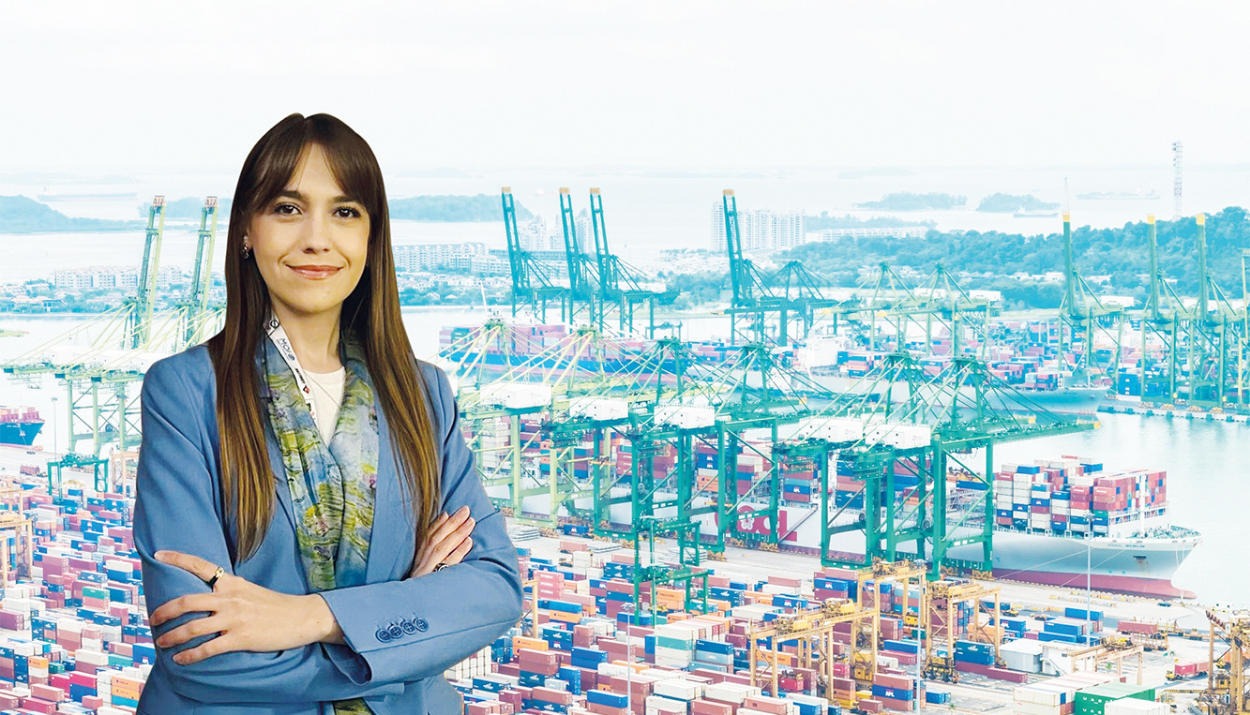
Türkiye is emerging as a strategic hub in maritime trade, going beyond being just a transit point. We discussed the current state and growth areas of the industry with Shipsider Founder Ayşe Aslı Başak. Highlighting that the total amount of cargo handled at Turkish ports in 2025 increased by 4 percent to reach 553.3 million tons, the highest level in the history of the Republic, Başak noted that approximately 75 percent of this cargo consisted of international freight.
While maritime transport forms the backbone of global trade, ports are increasing their strategic importance. Türkiye possesses a decisive potential in regional trade through its geographical location, expanding capacity, and production power. In this context, we met with Shipsider Founder Ayşe Aslı Başak to evaluate its position in port trade.
How would you define Türkiye’s role in port trade in general?
Türkiye is not merely a country that conducts its own foreign trade; it is a nation with the potential to be a strategic maritime logistics hub capable of directing regional trade flows within the “Blue Homeland.” Its location at the intersection of maritime trade routes connecting the Black Sea to the Mediterranean, and Europe to the Middle East and Asia, transforms Turkish ports from simple cargo handling points into vital nodes of global supply chains. Today, ports are no longer just safe harbors for ships; they are strategic centers where trade, industry, logistics, and data management converge. When viewed from this perspective, Türkiye’s role in port trade should be recognized as one of the most critical infrastructures of the production and export economy. Approximately 85 percent of world trade is carried out by sea, and roughly 85 to 90 percent of Türkiye’s foreign trade cargo is transported through ports on a tonnage basis. In recent years, the total annual volume of cargo handled at Turkish ports has surpassed 500 million tons. In 2025, the total cargo volume handled at Turkish ports increased by 4 percent to reach 553.3 million tons, marking the highest level in the history of the Republic. Approximately 75 percent of this volume consists of international cargo.
- What are the advantages and disadvantages that Türkiye’s geographical location provides to port trade?
Türkiye’s greatest advantage is its location on the Suez Canal, Mediterranean, and Black Sea route and being the sole gateway to the Black Sea through the Istanbul and Dardanelles Straits. This turns Türkiye into a natural logistics and distribution hub. Its proximity to European, Middle Eastern, North African, and Caucasian markets provides a significant logistical advantage for production and export sectors. Türkiye’s true potential will emerge when its geographical location advantage is supported by logistics infrastructure, railway connections, and digital port systems. Approximately 80,000 ships pass through the Istanbul and Dardanelles Straits annually, a figure that exceeds the number of transits through the Suez Canal. This situation demonstrates Türkiye’s geostrategy importance in global maritime trade. Approximately 12.5 percent of the cargo handled at Turkish ports is transit cargo, 12.6 percent is cabotage, and the remaining majority consists of foreign trade cargo. This shows that Türkiye holds an important position as both a transit and foreign trade port.
“Turkish ports have increased their capacities in recent years, thanks to correct port management policies”
- What is the share of ports in Türkiye’s foreign trade?
Approximately 85 to 90 percent of Türkiye’s foreign trade is conducted by sea on a tonnage basis, and this situation demonstrates that ports are essentially the invisible backbone of the Turkish economy. The vast majority of large-volume export products, raw materials, energy products, and container shipments are carried out via maritime routes. Consequently, ports are not merely logistical infrastructure but are also strategic economic centers upon which industrial production, export capacity, and economic growth are directly dependent. The strength of a country’s ports is, in fact, directly related to that country’s industrial strength and foreign trade competitiveness. While approximately 86 percent of Türkiye’s export and import shipments are carried out by sea on a tonnage basis, the volume of container handling has exceeded 12 million TEUs in recent years. In 2025, international cargo shipments by sea reached 414.4 million tons, representing an increase over the previous year. Furthermore, container handling volume hit a historic record of 13.9 million TEUs. Turkish ports have increased their capacities in recent years, thanks to correct port management policies, and this growth continues across the “blue homeland” through digital infrastructure enhancements.
“A significant advantage for Türkiye is that it possesses a cargo volume based on real production and exports”
- How does Türkiye’s position in port trade compare to its rivals in the Mediterranean and Black Sea basins?
While Türkiye possesses a strong port infrastructure in the Black Sea basin, it ranks below major transshipment hubs in the Mediterranean, particularly in terms of container transshipment. However, a significant advantage for Türkiye is that it possesses a cargo volume based on real production and exports rather than merely transit cargo. Thanks to a growing volume tied to industrial production and exports, Turkish ports have sustainable growth potential. Through correct logistics planning, railway connections, free zones, and logistics center investments, Türkiye can become a logistics base in the Eastern Mediterranean and Black Sea regions. Among the port regions where the most cargo is handled in Türkiye, Aliağa (89.5 million tons), Kocaeli, and İskenderun stand out; these ports operate as centers for industrial and energy transport. Looking at the distribution of cargo handled at ports in 2025, the largest share belongs to liquid bulk cargo at 169 million tons, followed by solid bulk cargo at 160 million tons and container cargo at 144 million tons. This indicates that Turkish ports play a vital role, especially in energy and raw material transport. In 2025, approximately 2.97 million vehicles were transported via Ro-Ro shipping, and these lines play a strategic role in Türkiye’s logistical connection with Europe.
“Turkish ports have the potential to become a regional logistics and trade hub in the next 10 years”
- What kind of development or transformation do you expect in Türkiye’s port trade in the coming period?
In the coming period, the greatest transformation in Turkish port management will take place in the areas of digitalization, automation, AI-supported port operations, the development of rail-connected logistics centers, and green port investments. Due to European Union carbon regulations and sustainable transport policies, it will be necessary to invest in the energy efficiency of ports, shore-to-ship power systems, electric equipment, and carbon monitoring systems. At the same time, ports will transform into digital platforms where trade data is managed, logistics flows are planned, and supply chains are optimized, rather than being sites that merely handle cargo. When integrated with logistics centers, railway networks, and digital systems, Turkish ports have the potential to become a regional logistics and trade hub in the next 10 years.