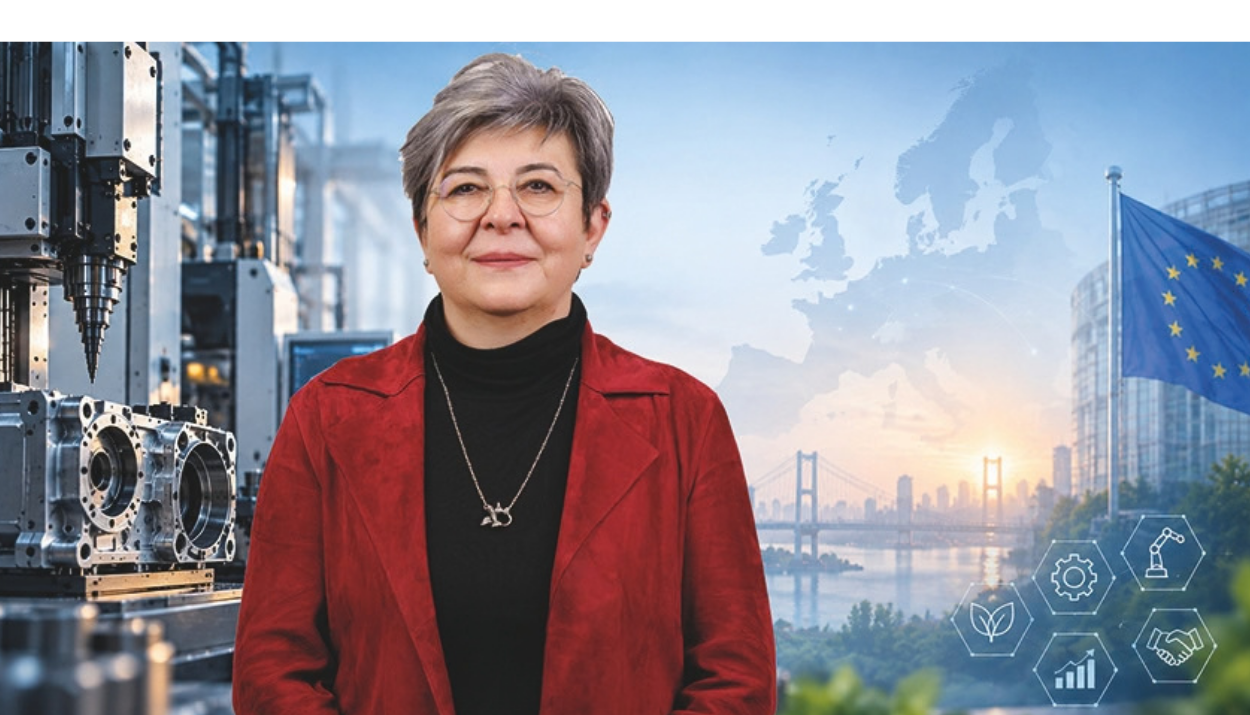
As the machinery industry continues its transformation in line with the goals of digitalization, sustainability and high value-added production, competition in global markets is also being shaped by new dynamics. Sevda Kayhan Yılmaz, Chairperson of Turkish Machinery, assessed the Turkish machinery sector’s export performance, new market opportunities and the issues that will guide the future of the sector.
As one of the fundamental building blocks of the production ecosystem, the machinery industry is at the center of technological developments and industrial investments. While an efficiency-oriented production approach, the spread of digital technologies and sustainability goals shape the future of the sector, manufacturers are also focusing on securing a stronger position in international markets. Standing out with its strong engineering infrastructure, production capability and export performance, the Turkish machinery sector is strengthening its role in global value chains every day. In our interview with Sevda Kayhan Yılmaz, Chairperson of Turkish Machinery, we discussed the sector’s current outlook, developments in export markets, the sustainability-oriented transformation and expectations for the coming period.
- You recently assumed the position of President of Machinery Exporters’ Association. What will be the priority items on your agenda in the new period?
At our family company, which has completed 75 years in the field of hydraulic cylinders, I started from the ground up and learned the ropes right on the production floor. After serving at every level of our sector organizations, I see becoming President of Machinery Exporters’ Association today as a continuation of our corporate culture and the collective wisdom that carried us into the global league. Our greatest priority in the new period will be to elevate the international perception of the Turkish machinery sector to that of a strategic partner that develops high technology and provides solutions. In this direction, while focusing on structural steps that will expand the financial room for maneuver of our companies, we will support their full compliance with Twin Transformation regulations and place their digital traceability infrastructure at the center of our innovation strategy. We will consolidate our strong position in international competition through digitalization, sustainability and our high engineering capacity.
- With which countries does the Turkish machinery sector currently have the most intensive trade relations?
Germany is unquestionably our traditional leader in machinery exports and the country with which we have the deepest production integration. In the first 5 months of 2026, our sales to Germany rose by 9% to $1,4 billion. Germany is followed by the United States, where we achieved a very significant momentum of 30,5% during this period and reached an export level of 950$ million. Italy, which maintained third place with 531$ million, also holds critical importance among our main markets. In contrast, due to the impact of geopolitical developments in the surrounding region, Iraq, Russia and Poland stand out as the major markets in which we experienced the greatest contraction during this period.
- What picture stands out on the export and import sides?
Our annualized consolidated machinery exports have reached $28,7 billion with an increase of 1,9%. When examined by subsector, we recorded the highest exports in the internal combustion engines and components group at $1,1 billion. This was followed by construction and mining machinery at $765 million and pumps and compressors at $655 million. Turbines, turbojets and hydraulic cylinders were the subsector with the highest increase during the period, at 26%.
- In which areas are the continuing uncertainties in the global economy affecting the machinery sector?
The most direct impact of global uncertainties is felt in access to finance and cost pressures. High customs tariffs and protectionist policies have made industrial investments more cautious worldwide. As regional crises along the Strait of Hormuz and Red Sea route disrupt logistics routes, they are creating billions of dollars in new costs for global industry. This situation is forcing us into two strategic transformations. First, in this climate where the focus of investments is changing, our traditional machinery lines must undergo an integration process that is fully compatible with increasing defense and security spending, particularly in Europe, and meets special certification requirements. Second, the need to adapt rapidly to the West’s new generation of protectionist barriers focused on cybersecurity and low carbon is coming to the fore.
“As the Turkish machinery sector, we should view this process as proactive opportunity management rather than a risk”
- On the one hand, China’s unstoppable growth and, on the other, the new trade agreements implemented by the EU are restricting our export markets. How do you recommend that the Turkish machinery sector manage this process?
The EU is currently in a serious strategic dilemma. While attempting to erect protectionist barriers against China on the one hand, it is seeking new Free Trade Agreements (FTAs) with markets such as MERCOSUR and India on the other to offset high production costs. As the Turkish machinery sector, we should view this process as proactive opportunity management rather than a risk. Europe’s industry can maintain its global competitiveness not merely by turning inward but through a country such as Türkiye, a Customs Union partner with full technical integration. My recommendation to our companies is that they position themselves not merely as a low-cost external stakeholder but as a rational partner that complements the European value chain and is included in the definition of “Made in EU.” While competing with the East’s raw material monopoly and production advantage, we must establish our identity as a reliable partner everywhere in the world by fully complying with the West’s cybersecurity and carbon standards.
“European Union regulations are no longer a choice but a ticket to market entry”
- What impact are the EU’s new regulations focused on green transformation and sustainability having on the sector?
EU regulations such as the green transformation and the Carbon Border Adjustment Mechanism are no longer a choice but a ticket to market entry. Although this initially creates a serious compliance and financing burden for our companies, it is in fact the greatest field of innovation that will reinforce our global competitiveness. We are making criteria such as energy efficiency, reducing the carbon footprint and digital traceability an integral part of our business processes. Through our investments in digital infrastructure that tracks the life cycle of products and in circular economy principles, we are competing directly in the same league as European industry. I believe that our ability to adapt early to environmental standards has made us a much more indispensable and secure harbor compared with Asian manufacturers.
- What level have digitalization and automation investments reached in the machinery sector? How are companies approaching this transformation?
Türkiye’s machinery industry has the determination to follow technological trends around the world simultaneously. The investments made by our export-oriented companies in automation, data analytics and the digital integration of production processes in particular are at a very advanced level. Our companies’ approach to this transformation is extremely visionary. We no longer regard digitalization merely as a tool for efficiency or cost reduction; we regard digitalization as the key to quality, traceability and sustainability. Our main objective at present is to spread this high technological threshold achieved by our leading companies and the “Twin Transformation” synthesis across a broader manufacturer base in our sector.
- What are your expectations for the remainder of 2026?
Our greatest expectation for the remainder of 2026 is that the additional cost pressures created by the conflict environment in the Middle East on global energy routes and logistics processes will achieve balance as soon as possible. We believe that the financing channels needed by our industrialists will be kept more open as technical bottlenecks in financial markets and restrictions on foreign-currency loans are eased. In the second quarter of the year and thereafter, even if protectionist winds continue in the global market, the fact that trust and flexibility in supply chains are becoming more decisive parameters than price will present a favorable picture for Türkiye. By standing out as an island of stability with our secure production capacity and operational flexibility, we aim to transform our existing industrial potential into high efficiency and the strongest weapon in the fight against the current account deficit.