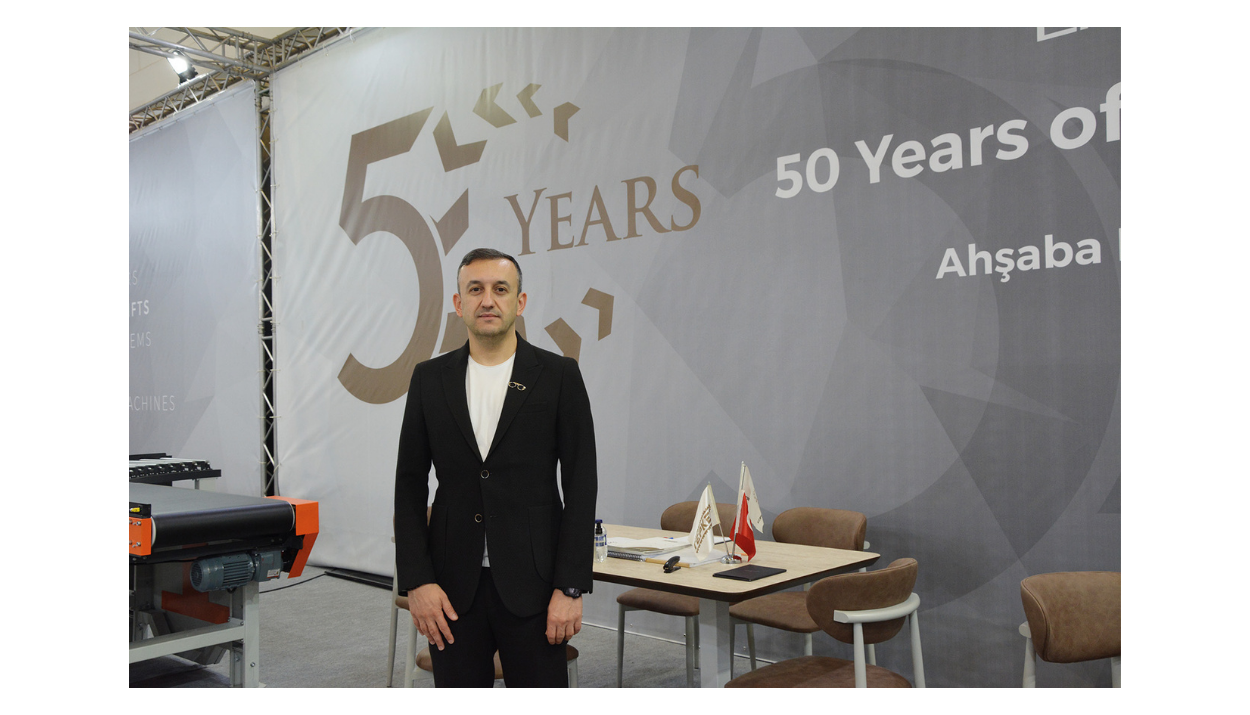
Operating in the Turkish woodworking machinery sector since 1975, Canmaksan aims to stand out in increasingly competitive markets through customer-specific systems and solutions it develops. In our interview with Canmaksan Partner Ozan Can, we discussed in depth the sector’s performance in 2025, expectations for 2026, and why offering customized solutions to customers is becoming an ever more decisive factor in competition.
We discussed the fluctuations experienced by the woodworking machinery sector over the past two years, the global competitive conditions faced by manufacturers, and expectations for 2026 with Canmaksan Partner Ozan Can. From the perspective of Canmaksan, which has been manufacturing in the sector since 1975, we discussed how to manage quality competition with Germany and Italy and price competition with China simultaneously, the impact of trade fairs on production and order processes, and why automation and efficiency focused solutions have become inevitable.
- How did 2025 go for the woodworking machinery sector overall? How would you assess the sector’s performance?
When we evaluate 2025 from the perspective of our sector, it is possible to say that there is a clear difference between the first six months and the second six months, especially for domestic manufacturers. It would not be accurate to say that the first half of the year was positive for the sector. I can say that this period was challenging for many of our companies. Companies participating in the LIGNA Fair held in May, in particular, had high expectations for the fair. Of course, positive feedback was received, but it is difficult to say that all expectations were met. The second half of the year was a period that passed more quickly and saw some movement, albeit limited. This assessment reflects a general opinion formed not only based on our company, but also on discussions, conversations, and industry dialogues with other machine manufacturers. However, we must not overlook the possibility that the weak performance in the first six months may have led to the relative activity in the second six months being perceived more positively. The key point is the comparison between 2024 and 2025. This comparison should be evaluated not only in terms of turnover but also in terms of the number of machines and products manufactured or sold. Speaking specifically about our company, we experienced a more intense and rapid production process in the second half of the year, partly due to the impact of the LIGNA and WoodTech fairs. Compared to the first six months, I can say that the second half was filled with production. Looking at the year as a whole, I cannot say that 2025 was worse than 2024. However, it is also necessary to state that it fell short of expectations. Ultimately, every company wants to grow financially and morally compared to the previous year, and in fact, it must grow. We cannot afford to stand still because our competitors are moving forward quickly.
“We aim to expand our dealer network across every region of the world”
- Which manufacturers do Turkish woodworking machine manufacturers compete with?
As the Turkish woodworking machinery sector, we have to compete with Germany and Italy on the quality side and with China on the price side at the same time. While our sales are mainly to Europe, customer price expectations can be at the level of China. This puts us in a two-sided competition. I liken this process to riding a bicycle. If you stop pedaling, you fall. Therefore, I believe that companies must grow every year, even if it’s only by 10-20%, within the rates they set for themselves.
- What are your predictions for 2026? What is your prediction for the first quarter in particular?
Evaluating our predictions for 2026, I can say that I predict a positive outcome, especially for the first quarter. Specifically for our company, I believe that the momentum we gained in the second half of 2025 will carry over into 2026. The main reason for this is our belief that a significant portion of the meetings, conferences, and customer visits we conducted after the trade fair will come to fruition during this period. In the European market in particular, our customers and distributors who allocate budgets for our products usually place their orders in the first four months of the year. Therefore, from our company’s perspective, I can say that the season starts in September-October and continues until March-April. In this context, I hope that the first quarter of 2026 will be a good one for our company
“Artificial intelligence-supported projects are on our agenda”
- As Canmaksan, in which areas do you plan to invest in 2026?
For our company, human resources are at the top of our investment plans for 2026. As a company engaged in specialized production, we have an ongoing R&D process. Every day, a new design, a new product, and a new project emerges. Therefore, investing in human resources is inevitable for us. We need to bring new engineers, new technicians, new operators, and new foremen into the system. In addition, artificial intelligence-supported projects are on our agenda in terms of making machines smarter. We implement this process primarily at the design stage. We are working on AI-supported design solutions through the software and programs we use. This contributes to us, especially in terms of speeding up the design processes and completing projects in a shorter time. However, the key factor here is still human resources. After all, if there is no one standing before the computer, artificial intelligence alone has no meaning. Frankly, it is difficult to say that we are in an environment where very large-scale investments can be made under the current conditions. Our priority is to get orders, complete projects, keep our promises, and finish production on time. If we have the time and cash, other investment areas can be evaluated. However, these are investments that should be considered once a certain level of comfort has been achieved. For today, I would say the most critical areas are speeding up design processes and maintaining strong human resources.
“There has been a significant increase in demand from Arab countries in recent times”
- What do you think are the top three target markets for the sector in 2026? What strategies are you focusing on to increase your competitiveness in your export markets?
The target market is quite important for our sector. We see from our discussions, meetings, and conversations with other machine manufacturers that, as a sector, we already sell largely to the European market. We can supply products to countries such as the UK, Poland, and Belgium, especially the Balkan countries. Italy should be considered separately at this point. Apart from that, it is possible to say that Turkish machines are present in most of Europe. Sales to Russia were made in the past, but I can say that there has been a decline in this market recently due to the pressure created by Chinese competitors. In addition, we can supply products to North African countries, primarily Morocco, Tunisia, and Algeria. In recent times, there has been a significant increase in demand from Arab countries. We are seeing that companies that previously imported and sold furniture from Türkiye now want to manufacture directly in their own countries. This is leading to new investments and the opening of new factories. Therefore, we are also able to sell to this region. As Turkish manufacturers, I believe that the region where we are currently relatively weak is America. When I say America, I am referring to a market that includes not only the United States but also Canada and South American countries. Intensive work is being carried out across the sector regarding these regions. As you know, many Turkish participants attend the IWF Fair, which is held every two years in America. Many companies also participate in the Fair in Las Vegas. I have also seen Turkish companies from the woodworking sector participating in a fair held in Brazil. I believe we need to focus more on these regions. When I evaluate our company specifically, Canada, the United States, and South American countries are currently among our target markets.
- Sustainability has become a critical issue for exporting companies. Many new regulations and sanctions are on the horizon. Is your company keeping up with these developments and making adjustments internally?
The automation solutions we have developed within the scope of Industry 4.0 have come to the fore as systems that reduce labor and increase efficiency. Our customers are facing intense competition, particularly in terms of price and speed. The expectation for systems such as CNC cutting, CNC drilling, and CNC routers to work faster, smarter, and more efficiently brings smart factory solutions to the forefront. However, I do not believe the industry is ready for the “dark factory” concept, which refers to fully autonomous production. Allocating budget for production space, human resources, and high-cost lines on this scale is challenging for our customers. Nevertheless, it is clear that this transformation is inevitable. Innovative technologies must remain the focus of the industry, and companies need to invest in these areas to increase their efficiency and competitiveness. I hope that both machine manufacturers and our customers in the woodworking industry will support this transformation on the investment side as well.
“Our products increase workplace safety and boost productivity”
- What kind of benefits do you provide to your customers as Canmaksan?
The most important factor that sets our company apart is that we offer customized solutions to our customers. We have found that we can satisfy our customers as long as we develop products tailored to the individual and their needs. In recent years, we have clearly observed that companies engaged in standard production must either come up with major innovations, produce very economically, or produce very quickly. Otherwise, it becomes difficult to remain competitive. We are all competing with Chinese manufacturers. We cannot be as fast or economical as the Chinese. Due to our high labor costs, energy costs, and general expenses, it is not possible for us to go below a certain profit margin. This can sometimes cause our prices to remain high. At this point, the solution is to add new features to our products. In this context, making machines smarter, configuring them, or offering automation solutions by establishing inter-machine connections comes to the fore. As a company, we visit our customers on-site, listen to their needs, and design and implement the most suitable solution. This allows us to respond more clearly to our customers’ demands. The solutions we offer help our customers stay one step ahead of their competitors. Ultimately, if everyone produces the same product with the same quality, customers will gravitate toward the more affordable option. With the systems we offer, customers can either achieve more economical production or gain a competitive advantage through more efficient and faster production. Fast and high-quality production naturally puts them ahead in price competition. This approach summarizes our company’s fundamental working method. I believe we are preferred because we offer solutions that contribute to our customers’ production processes, particularly by increasing their efficiency. Of course, this process is neither easy nor quick. Developing, designing, and scripting a project and presenting it to the customer requires significant time and effort. It does not progress as quickly as standard product manufacturing. Given our company’s product range, we develop transportation and automation systems that carry, lift, rotate, and transfer products between machines. These systems enhance workplace safety, increase efficiency, and boost production speed while prioritizing operator health and safety. All these factors are decisive in our customers’ choice to work with us.