
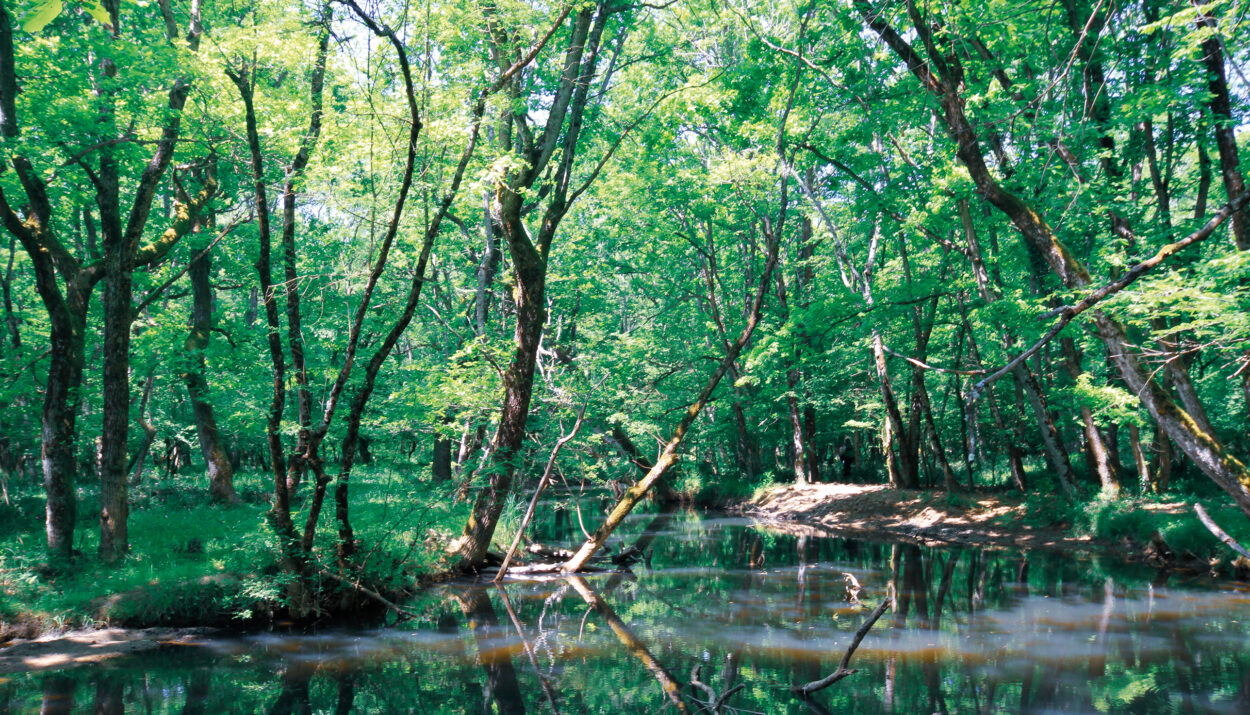
Did you know that one of the world’s rarest ecosystems, the longoz (floodplain) forest, found only in the Amazon and Congo, is located in Türkiye? Covering an area of approximately 3,515 decares, the İğneada Longoz Forests are the largest floodplain forests in Europe and Türkiye. With trees, streams, and lakes that are completely submerged during certain seasons, and their biological diversity, they are one of Türkiye’s most important forest assets.
A natural wonder rarely seen in the world. A cycle that has continued for thousands of years… An ecosystem, biological diversity hidden in this magnificent cycle of nature, where life exists, thrives, and continues… Imagine streams and rivers fed by snowmelt from the mountains and rainwater, striving to reach the sea. As these small streams strive to reach the sea, they carry along whatever they find; trees, logs, branches, leaves. Then, in some places, the flow slows down, and the streams are blocked… The Black Sea is their destination, but reaching it is no easy feat… The Black Sea piles up sand dunes with its huge waves, forming barriers in front of the streams… Streams blocked on all sides turn into small lakes. Then the rains fall, the snow melts, the sea overflows, the stream meets the sea, the sea meets the lake. The rising waters flood the forests, submerging them. And this natural miracle nourishes the trees, birds, and creatures. It teaches us that every flood, every torrential rain, is not a disaster, but essential for the vitality of this ecosystem, seen in very few places in the world like the Amazon and Congo…
This natural wonder we are referring to is called a floodplain forest. It is also known as a longoz forest. With its diverse fauna and flora, the İğneada Longoz Forests are one of Türkiye’s most important natural habitats, home to hundreds of species of plants, animals, and birds, making them one of Türkiye’s most significant forest assets. Located 100 kilometers from the center of Kırklareli, 230 kilometers from Istanbul, and 174 kilometers from Edirne, the İğneada Longoz Forests are lush like a wetland forest and rainforest. However, unlike rainforests, they depend not only on rainfall and air humidity but also on groundwater, resembling the mangrove (swamp) forests of tropical regions in this respect. Of course, the forest is not constantly under water. This natural phenomenon occurs six or seven times a year, depending on rainfall and wave action. The flooded areas are generally not very deep, but in some exceptional places, the water depth can reach one meter. However, at many points, the water is usually 30-60 cm deep. In the Longoz forest type, since the forest floor is partially submerged, the trees grow with the clay and moisture brought by the water. The water enriches the soil of these areas with the clay and organic material it brings, making it rich in minerals and organic matter.
Its existence depends on groundwater
One of the reasons why longoz forests are rare in the world is that they absolutely need groundwater to survive. The İğneada Longoz Forests have preserved their existence for centuries thanks to the streams originating from the Yıldız Mountains and flowing into the Black Sea. This rare treasure, found in only a few places around the world, was declared a National Park in 2007 and is now fully protected. Research shows that most of the longoz forests in Europe have dried up, unfortunately due to bombs dropped during World War II.
Scientists have conducted numerous studies in the İğneada Longoz Forests. As a result of their studies, they determined that this area consists of three forests with different characteristics. In the İğneada Longoz Forests, there are lakes named Mert, Erikli, Saka, Pedina, and Hamam, formed by rivers flowing from the melting snow and rain in the Yıldız Mountains towards the sea. Scientists have also named the three different forests they studied after the lakes they contain: Saka Lake Longoz, Mert Lake Longoz, and Erikli Lake Longoz.
472 plant species, 453 bird species
Longoz Forests are a formation where dune ecosystems, wetland ecosystems, floodplain ecosystems, and deciduous ecosystems coexist. Therefore, they are quite rich in terms of biological diversity. İğneada Longoz Forests National Park is home to 472 different plant species, including 17 rare plant species that only grow in this region. Of the 453 bird species found in Türkiye, 258 are found in İğneada, and 668 species of wild animals live in the forest. According to the Bern Convention criteria, 184 bird species that stay or live in the region are among the bird species that need to be protected.
The tree diversity of the İğneada Longoz Forests is also quite rich. In the areas where the longoz is located, trees similar to rainforests, which depend on groundwater, can be seen. With heights ranging from eight to ten meters, these trees appear majestic, yet their slender trunks make them equally delicate. The trees depend on water flowing from the lake to survive. These trees are very close to each other, making the interior of the forest somewhat darker. The forest area also contains a high concentration of broad-trunked, tall, deciduous old trees. The forest is home to many tree species, such as beech, hornbeam, oak, elderberry, ash, linden, elm, redwood, white poplar, plane tree, walnut, cornelian cherry, and hazelnut, and the vines that wrap around the tree trunks create a tropical look. It is also possible to see dense populations of water chestnuts and water lilies in the area.