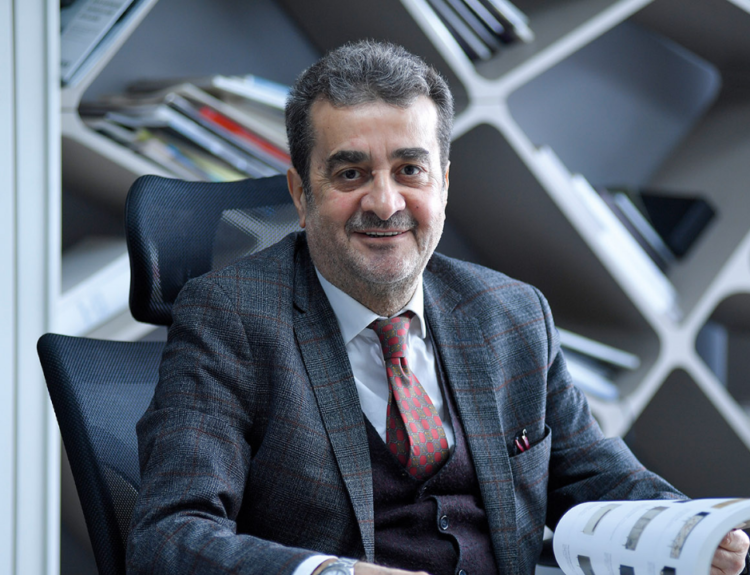
The furniture sector is undergoing a process of rebalancing and adaptation amid shifting dynamics on a global scale. Key priorities during this process include diversifying export markets, strengthening functional and sustainable design approaches, and making more effective use of digital sales channels. Levent Çapan, General Manager of Tepe Home, assessed the sector’s current outlook, expectations for 2026, and the position of the Turkish furniture sector in international competition.
In line with shifting consumer expectations and developments in global markets, the furniture sector is undergoing a multifaceted transformation. During this period, companies are focusing on increasing operational efficiency, strengthening their design-oriented approaches, and placing greater emphasis on sustainable production practices. At the same time, the opportunities offered by digital sales channels are creating new areas of opportunity within the sector. In this context, we sat down with Levent Çapan, General Manager of Tepe Home, to assess the transformation the sector is undergoing, trends in export markets, and changes in consumer behavior.
- How would you assess 2025 from the sector’s perspective? How was the first quarter of 2026?
2025 stood out as a period in which financial discipline was a key factor for the furniture sector. As economic uncertainties continued to impact demand, companies focused on operational efficiency, appropriate pricing strategies, and sustainable business models. Rising energy, rent, raw material, and logistics costs strained profitability; difficulties in accessing financing led to a cautious approach on both the producer and consumer sides. As the digital presence in sales channels grew even stronger, project-based work provided a certain balancing factor in the domestic market. While companies with strong brands and extensive sales networks demonstrated more resilient performance, it was a more challenging year, particularly for small and medium-sized enterprises (SMEs). In this regard, 2025 can be characterized as a year where the focus shifted from growth to financial resilience and operational efficiency. We are seeing strengthened expectations of stabilization in the first quarter of 2026. While export-driven growth strategies and project-based business models are becoming more prominent, a more rational and planned consumption trend is gaining attention in the domestic market. In this context, the sector aims not only to regain its growth momentum but also to establish a more predictable, planned, and sustainable development model as a permanent feature.
“The Turkish furniture sector is operating steadily in the Middle Eastern and European markets”
- What are the Turkish furniture sector’s most important export markets? Which new countries do you think might be added to these markets by 2026?
The Turkish furniture sector has been operating steadily in the Middle East and European markets for a long time. These regions hold strategic importance for the sector in terms of logistical advantages, delivery times, and established commercial relationships. In addition, there is growing interest and a steady volume of trade in markets such as the United States and the United Kingdom. Türkiye’s rapid production capacity, advantage in delivery times, and project-based flexibility are among the key factors supporting its competitive strength in these markets. Looking ahead to 2026, we see market diversification strategies gaining greater prominence. Developing countries in Africa, the Central Asian region, and the North American market present notable potential for deeper penetration. Increasing urbanization, housing investments, and changing lifestyles are creating new opportunities in these regions. It is fair to say that the Turkish furniture sector has the potential to strengthen its position in these markets thanks to its balance of design and price, as well as its production flexibility.
“Türkiye’s most significant advantage lies in its strategic geographic location and flexible production structure”
- Which countries are the sector’s main competitors? What are Türkiye’s advantages and disadvantages in this competition?
On a global scale, countries such as China, Vietnam, Poland, Germany, and Italy are major producers and exporters. China stands out for its scale and cost advantages; Italy for its design strength; and Poland for its proximity to the European market and production capacity. Türkiye’s most significant advantage lies in its strategic geographic location and flexible production structure. However, sensitivity to currency fluctuations, fluctuations in raw material costs, and labor costs are the primary risk areas that must be carefully managed within the sector.
“E-commerce and omnichannel sales structures are accelerating the sector’s transformation”
- What trends will shape the furniture market for the remainder of 2026?
In 2026, sustainability, modularity, and digitalization are among the sector’s key areas of transformation. With the rise of smaller living spaces, demand for multi-purpose and functional products is growing. Consumers are no longer seeking merely aesthetic appeal; they are looking for solutions with high utility value, durability, and longevity. Additionally, e-commerce and omnichannel sales structures are accelerating the sector’s transformation. The ability to compare products online, customization options through modular designs, and expectations for fast delivery have become more pronounced. On the design front, a trend toward timeless, simple, and natural lines is gaining prominence.
- In your opinion, what design and style characteristics set the Turkish furniture sector apart on the international stage?
The Turkish furniture sector stands out for its ability to harmoniously blend modern design with quality. Its ability to deliver both functionality and aesthetic appeal is one of the sector’s key advantages. In recent years, there has been an increased emphasis on branding and design investments, leading to a stronger presence at international trade fairs and commercial events. Value-added and original designs are among the fundamental elements strengthening Türkiye’s position in global competition.
“Functionality and aesthetics are expected to go hand in hand”
- What changes have you observed in consumer behavior recently? Is there a shift toward more functional products or design-focused collections?
Recently, we’ve seen a more conscious and comparative approach emerge in consumer behavior. Factors such as the price-performance balance, product durability, and after-sales service have become decisive in purchasing decisions. Consumers are evaluating products not only based on aesthetics but also on their lifespan and functionality. As a result, functional solutions, designs that offer storage advantages, and quality standards that ensure long-term usability are gaining greater importance. However, this does not mean that design has taken a backseat. On the contrary, functionality and aesthetics are expected to go hand in hand. The tendency to conduct research through online channels, compare products with different alternatives, and consider user reviews is shifting the purchasing process toward a more rational structure. This, in turn, makes transparency and trust even more critical for brands.
- Sustainability is now one of the key elements of competition. What are your priorities and goals in this area?
We do not view sustainability as a topic limited solely to environmental practices. For us, sustainability means producing long-lasting, modular, durable, and timeless products. We prioritize ensuring our products retain their value for years to come through the selection of high-quality materials and robust production standards. A longer lifespan supports a more conscious approach to consumption. This approach both strengthens customer trust and enhances the brand’s longevity. The concept of the circular economy, which is increasingly discussed in the sector today, is actually based on the idea of extending a product’s lifespan and preserving its value. We, too, approach sustainability within this framework as a responsibility to create long-term value.
“Turkish woodworking machinery has shown significant progress in terms of technology and quality in recent years”
- How would you assess Turkish woodworking machinery? What percentage of your production is carried out using domestic machinery?
Turkish woodworking machinery has shown significant progress in terms of technology and quality in recent years. Solutions capable of meeting the sector’s needs, particularly in the areas of automation and production precision, are now being offered. Generally, the sector operates with a structure that combines both domestic and imported machines. While imported machines are preferred for certain processes requiring high technology, the technical support and service access provided by domestic manufacturers offer significant advantages in terms of operational continuity. For this reason, we anticipate that the use of domestic machinery may increase further in the coming period. Our approach is to prioritize production quality and operational efficiency; we adopt a performance-focused mindset in all investment and equipment decisions.