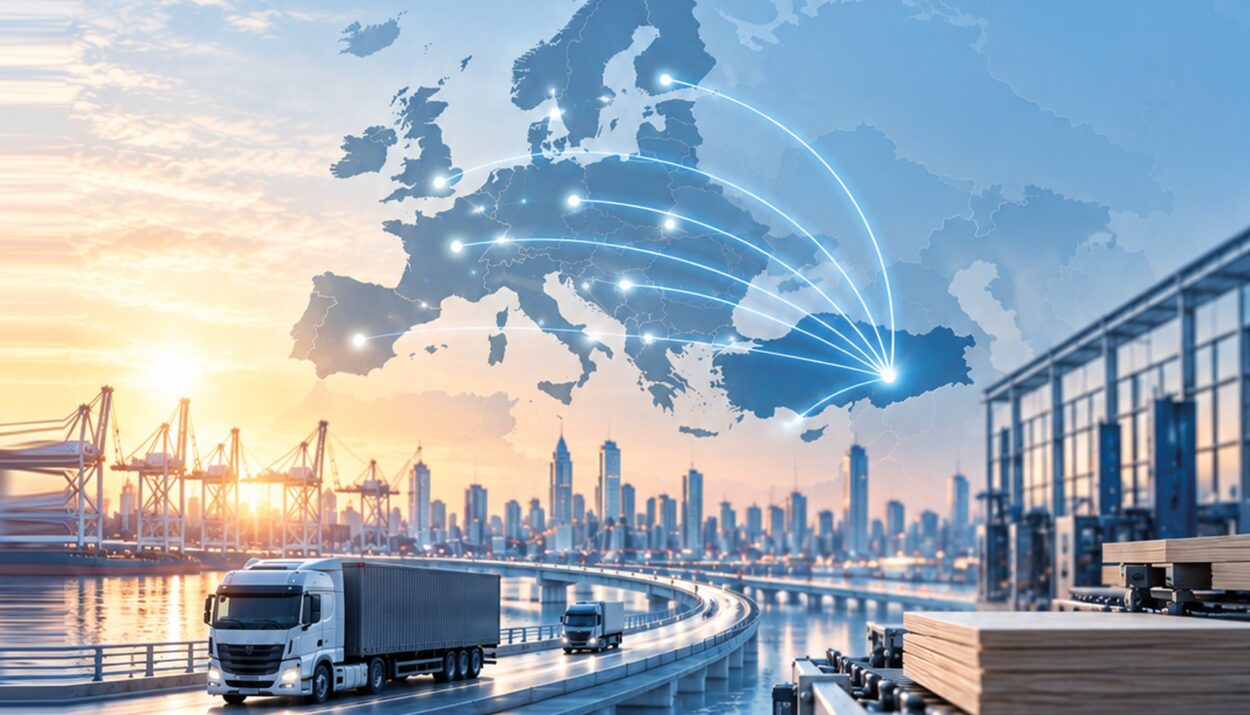
The rules of competition in the European market are changing. While delivery time and price remain important; sustainability, digitalization, engineering support, flexible production and after-sales services are becoming increasingly decisive in purchasing decisions. So, what advantages do Turkish machinery manufacturers stand out with in Europe in this changing competitive environment and how can they turn these advantages into lasting competitiveness?
The criteria determining supplier selection in Europe are being reshaped. Changes in the global supply chain, sustainability targets and the need for continuity in production are causing European companies to evaluate different criteria alongside price. This change brings Türkiye’s position back to the agenda with its proximity to Europe, production infrastructure and engineering capabilities. For Turkish machinery manufacturers, quality, flexibility, technical support, digitalization, traceability and after-sales services are becoming increasingly important.
In the European machinery market, price, product quality and delivery time continue to be among the main evaluation criteria. Production and logistics disruptions experienced during the pandemic made the importance of delivery times, inventory management and supply continuity in purchasing processes more visible. The failure to deliver a machine or critical part on time can lead to disruptions in production plans, delays in deadlines and increases in inventory costs. Therefore, when evaluating suppliers, European companies also take into account factors such as delivery capability, production flexibility and technical services, in addition to price.
Türkiye is one of Europe’s strong production partners
Türkiye is among the countries most affected by this change with its long-standing industrial and trade relations with the European Union, Customs Union, geographical proximity to Europe and extensive production infrastructure. While trade in goods between the European Union and Türkiye exceeded €217.6 billion in 2025, Türkiye maintained its position as the EU’s fifth-largest trading partner. In the same period, 42.7% of Türkiye’s total goods exports were made to European Union countries. Machinery and electrical equipment were also among the prominent product groups in trade between the two sides. This picture shows that the relationship between Türkiye and Europe is not based solely on geographical proximity. Turkish manufacturers have been producing according to European standards, technical regulations and customer expectations for many years. However, in a period when global competition is changing rapidly, existing commercial relations alone do not provide a lasting advantage. Türkiye’s ability to strengthen its position in the European market appears to depend on supporting its existing proximity and production capability with higher value-added services.
Türkiye’s strong reference in European industry: Automotive
One of the most concrete examples of Türkiye’s strong production relationship with European industry is the automotive sector. According to OIB data, Türkiye’s automotive industry exports increased by 11.6% in 2025, reaching $41.5 billion, while the sector became the export champion for the 19th time in the last 20 years. The fact that approximately $30 billion of these exports were made to EU countries demonstrates the scale of the integration achieved by the automotive industry with Europe. The resulting picture shows that Türkiye is not only an exporting country for Europe, but an important industrial partner that has established strong ties with the continent’s production structure. This structure formed over the years in automotive also provides a strong reference for establishing deeper production and supply relations with Europe in other manufacturing industries.
Is Europe looking for an alternative to China?
Europe’s dependence on China has become one of the main topics of industrial policies and supply chain discussions in recent years. However, it would not be correct to evaluate Europe’s approach as completely abandoning China or moving all production to nearby countries. China continues to be one of the strongest actors in global trade with its production capacity, supplier network, technological development and cost advantage. From Europe’s perspective, the main objective is not so much to replace China with a single new supplier as to diversify supply sources and reduce dependence on any one country or region. On the other hand, China is not only an important supplier, but is increasingly becoming a stronger competitor for producers in Europe. According to the European Central Bank’s 2026 assessment, the increasing presence of Chinese firms is creating important competitive challenges for the Euro Area, with an increasingly pronounced effect on economic performance both domestically and abroad. Therefore, Europe’s search is not merely to find a cheaper production center. Companies want to establish alternative supply channels against delivery delays or political and economic tensions without completely abandoning products and parts supplied from China. Türkiye’s opportunity also emerges at this point.
Türkiye is among the countries that can be considered in diversifying the supply chain thanks to its ability to produce closer to customers in Europe, road connections, industrial trade within the scope of the Customs Union and experience in producing according to European standards. However, it appears more realistic for Türkiye to position itself not as a production center that will replace China, but as a solution partner that complements Europe’s supply network, reduces risks and responds quickly to needs.
Proximity, speed and flexible production put the Turkish machinery sector ahead
One of Türkiye’s most visible advantages in the European market is delivery time. Compared with shipments made by sea from the Far East, deliveries made by road from Türkiye can reach many European countries in a shorter time. This time difference becomes important especially in cases of spare part needs, an unexpected breakdown in the production line or projects with a precisely determined delivery date. Another advantage provided by proximity in the machinery sector is the acceleration of communication between the manufacturer and the customer. Unlike the purchase of a standard product, machinery investments cover a long process consisting of project planning, determining technical details, production, factory acceptance tests, installation, commissioning, training and after-sales services. The manufacturer’s proximity to the customer makes it easier to respond more quickly to changes that may arise during these stages. Especially in the woodworking machinery sector, the production area, capacity, material processed, level of automation and target product of each factory may differ from one another. Therefore, customers do not always purchase a standard machine available in the catalog. Dimensions to be adapted to the existing line, special software requests, different feeding systems or additional solutions that will increase production capacity may be requested.
The more flexible production structures of Turkish manufacturers create significant room for responding to such changes. While the standardized systems of large manufacturers provide significant advantages in high-volume orders, decision-making and production processes can be longer for project-based and customer-specific demands. Turkish companies, on the other hand, can shape their production plans and technical solutions more quickly according to the customer’s request. However, delivery time alone is not a lasting competitive advantage. A customer may not choose again a machine that is delivered quickly but fails to provide the desired performance, has insufficient technical documentation or does not provide support in case of a breakdown. For proximity to turn into a real advantage, speed needs to be supported by quality, reliability and after-sales services.
Europe’s new criterion: not just price
Price remains important in the European market. Due to increasing energy, labor and financing costs, businesses carefully evaluate the total cost in their investment decisions. However, the purchase price of a machine no longer constitutes the only cost of the investment. Factors such as energy consumption, maintenance needs, production loss, access to spare parts, software updates, service life and service time determine the machine’s actual cost to the business. A machine with a low initial purchase price may become more expensive over time due to high energy consumption or frequent downtime. Therefore, for European customers, the total cost created by the product throughout its service life is becoming a more visible evaluation criterion. Sustainability is also becoming an increasingly decisive criterion in purchasing processes.
The European Union’s Ecodesign for Sustainable Products Regulation (ESPR) creates a framework for establishing ecodesign requirements aimed at improving the durability, repairability, reusability, recyclability, energy and resource efficiency, and environmental performance of products. The regulation allows specific requirements for different product groups to be determined in the future through delegated acts. This does not mean that the same environmental obligations apply to every machine today. However, the general direction in the European market is moving toward products that consume less energy, can be used for longer, are easy to maintain and repair, and use resources efficiently. For machinery manufacturers, energy efficiency is no longer merely a technical feature, but is evaluated as a sales factor affecting the customer’s operating costs and sustainability performance.
Digitalization and traceability are the new criteria of competition
Digitalization and traceability also constitute other parts of this transformation. The Digital Product Passport approach developed by the European Union aims to make information concerning products, components and materials accessible in electronic and machine-readable formats. Although this system is not expected to be implemented for all machinery groups on the same timetable and with the same scope, the digitalization of product information, traceability throughout the supply chain and accessibility of technical data indicate the direction of the new production approach in Europe. For machinery manufacturers, digitalization is not merely about adding a screen or remote connection feature to the machine. Tracking production data, predicting failures in advance, providing remote technical support, software updates, maintaining maintenance records and tracking spare part history expand the scope of the service offered to the customer. Therefore, offering a competitive price is still necessary in the European market, but it is not sufficient on its own. The manufacturer needs to clearly demonstrate the machine’s performance, energy consumption, technical specifications and the benefits it will provide during use.
Areas where Turkish manufacturers are strong
Turkish machinery manufacturers can stand out in the European market not only with their price advantage, but also in areas such as engineering support, customer-specific production and rapid after-sales service. Especially in projects where standard solutions are not sufficient, a flexible and direct communication-based working model provides a significant competitive advantage.
- Engineering support: Analyzing the customer’s production needs, determining the appropriate capacity and adapting the machine to the existing line.
- Customer-specific solutions: Developing systems suitable for the production area, product structure and budget in investments where standard machines are not sufficient.
- Flexible production capability: Offering machines at different levels of automation and rapidly reshaping projects according to changing demands.
- Direct technical communication: Involving technical teams in the sales process and responding more quickly to customer requests.
- After-sales service: Rapid intervention in breakdowns, remote technical support and delivering spare parts to the customer in a short time.
- Proximity to Europe: Enabling technical teams to reach the site more quickly and service processes to be managed in a shorter time.
How does the Turkish machinery sector make a difference in Europe?
There is no single way to make a difference in the European market. Türkiye’s competitiveness emerges from offering proximity, speed, flexibility, engineering and after-sales services together. Having only one of these elements is not sufficient under today’s conditions. While proximity ensures that the product is delivered in a shorter time, it also facilitates providing rapid technical support to the customer. Flexible production allows machinery to be developed according to the customer’s needs in projects where standard solutions are not sufficient. Engineering support ensures that the machine becomes not merely equipment purchased, but an investment that increases the efficiency of the production process. After-sales service makes it possible for the relationship between the manufacturer and the customer to continue after delivery. In terms of Türkiye’s position in Europe, the main objective should not be to become a direct alternative to China or another manufacturing country; it should be to create a unique value proposition. Turkish manufacturers need to position themselves not as a lower-priced option, but as business partners that work close to the customer, can make decisions quickly, can shape production according to needs and provide support throughout the machine’s service life.
In the competition of the future, not only the production capacity of machines but also their energy consumption, software infrastructure, connectivity features, data generation capability, ease of maintenance and performance throughout their life cycle will be decisive. Creating a green, digital and resilient industrial structure in Europe constitutes one of the main directions of the EU’s industrial policies. Therefore, for Turkish machinery manufacturers, the opportunity in Europe is not limited to selling more machines. Companies that can read changing purchasing criteria early, develop their products according to these expectations and transform their technical services into an institutional structure can achieve a stronger position. Competition in the European market is no longer based solely on price. The fundamental difference that will make a European customer prefer a Turkish manufacturer will be the provision of proximity and speed together with engineering, quality, flexible production and strong after-sales services. Turning Türkiye’s existing advantages into lasting competitiveness will also depend on managing these elements not individually, but as an integrated value proposition.